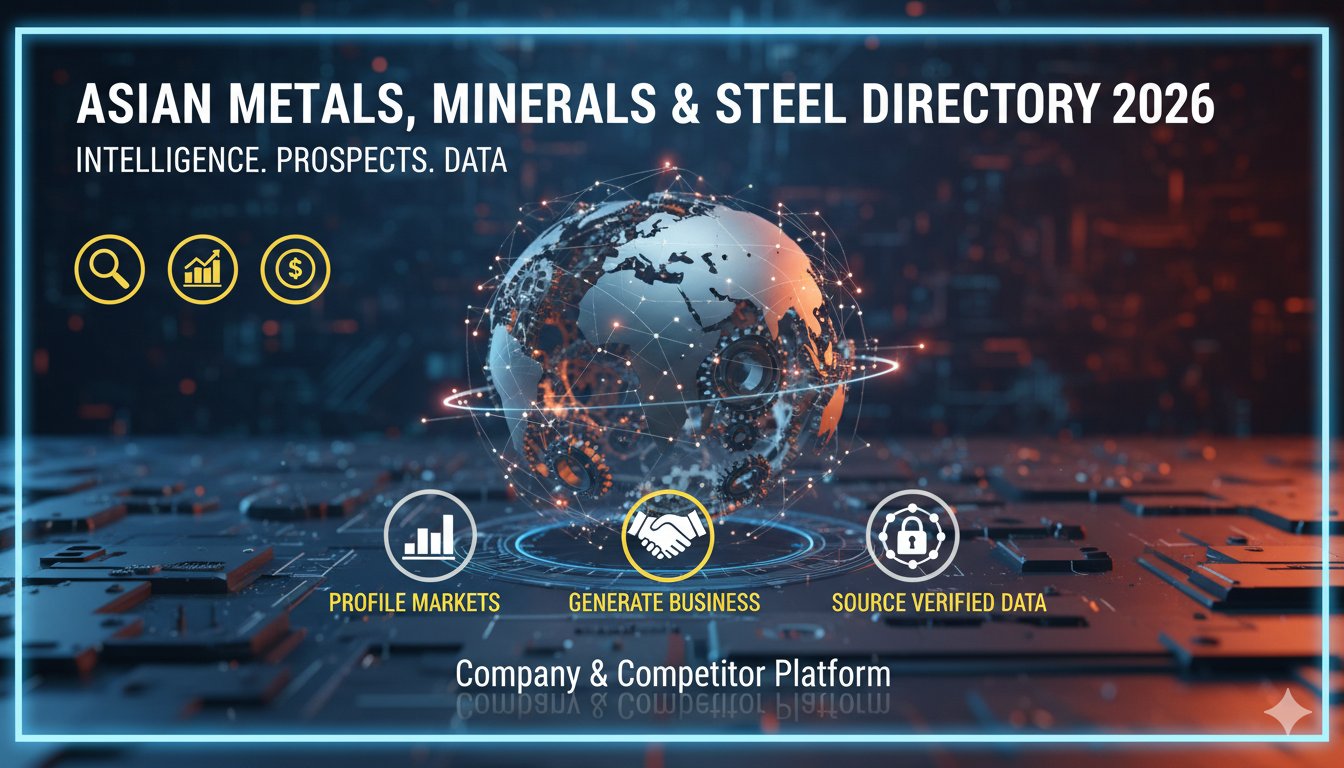
“The 2026 edition of the Asian Metals, Minerals & Steel Directory serves as a comprehensive intelligence platform, enabling users to profile regional markets, uncover new business prospects, analyze competitors, and access verified supplier details alongside executive contact information in one centralized tool.”
Asian Metals, Minerals & Steel Directory 2026: Unlocking Asia’s Booming Commodities Ecosystem
Asia continues to dominate global production and consumption in metals, minerals, and steel, accounting for the lion’s share of output in key categories such as steel, aluminum, copper, and critical minerals essential for energy transition and manufacturing. The region’s rapid industrialization, infrastructure investments, and export-oriented growth drive relentless demand, while supply chains face pressures from geopolitical shifts, environmental regulations, and raw material volatility.
This latest directory edition captures the evolving landscape by compiling extensive, up-to-date profiles on thousands of active players—from major integrated producers and state-backed enterprises to specialized traders, processors, and emerging suppliers. It focuses on actionable intelligence tailored for procurement teams, sales executives, market analysts, investors, and strategic planners seeking an edge in one of the world’s fastest-moving industrial arenas.
Key coverage spans iron and steel (including carbon, stainless, and specialty grades), non-ferrous base metals (aluminum, copper, zinc, lead, nickel), ferroalloys, precious and minor metals, and a broad array of industrial minerals vital for steelmaking, refractories, and advanced applications. The directory emphasizes Asia’s diverse geography, highlighting powerhouse economies like China, India, Japan, South Korea, and emerging contributors in Southeast Asia (Indonesia, Vietnam, Malaysia) and resource-rich nations.
Core Features and Intelligence Capabilities
The platform organizes data for maximum usability, allowing users to filter and search by multiple criteria:
Company type (producer, trader, processor, consumer, equipment supplier)
Product categories and specific grades/materials handled
Geographic location (country, province/city, export/import focus)
Executive and decision-maker contacts (verified names, titles, direct emails, phone numbers)
Operational details (production capacity, plant locations, annual output estimates where available)
Market positioning (export markets served, key certifications, sustainability initiatives)
This granular structure supports rapid competitor benchmarking. For instance, users can compare major steelmakers’ footprints in flat products versus long products, or assess non-ferrous smelters’ exposure to upstream mining versus downstream fabrication.
Market Profiling and Trend Insights
Asia’s metals and steel sectors exhibit unique dynamics in 2026. Steel production remains concentrated in China and India, with ongoing capacity rationalization efforts alongside green steel pilots using hydrogen and electric arc furnace routes. Non-ferrous demand surges from electric vehicle battery chains (nickel, cobalt, lithium intermediates) and renewable energy infrastructure (copper for grids, aluminum for lightweighting).
The directory aids in mapping these trends by profiling companies involved in critical mineral processing and rare earth elements, areas where Asia holds commanding positions in refining and value-added stages. It also highlights traders bridging domestic surpluses to global deficits, especially amid trade policy uncertainties.
Business Prospect Generation
One of the directory’s strongest suits lies in lead generation. Sales and business development professionals can target verified suppliers for raw materials, joint venture partners for downstream expansion, or buyers for excess capacity. The inclusion of executive-level data accelerates outreach, reducing reliance on outdated networks or generic directories.
For procurement, the tool streamlines supplier vetting by providing cross-referenced profiles, enabling faster due diligence on reliability, scale, and compliance.
Competitor Intelligence Applications
Strategic teams leverage the directory for SWOT-style analysis at scale. Track shifts in market share among top aluminum producers amid energy cost fluctuations, or monitor ferroalloy suppliers’ responses to ore price swings. The centralized format reveals consolidation patterns, new entrants in high-growth segments like specialty alloys, and potential acquisition targets.
Practical Sections and Data Organization
The directory employs clear sectional breakdowns for efficiency:
Iron & Steel Sector — Profiles integrated mills, mini-mills, stainless producers, pipe/tube makers, and service centers.
Non-Ferrous Metals — Dedicated segments for aluminum (smelters, extruders, foil), copper (refineries, rod/wire), zinc/lead, nickel, tin.
Ferroalloys & Minor Metals — Chromium, manganese, molybdenum, vanadium, tungsten, indium, germanium.
Industrial Minerals — Bauxite, fluorspar, graphite, magnesite, silica, zircon—key inputs for steel and metals processing.
Cross-Sector Traders & Logistics — Companies facilitating regional and international flows.
Tables within sections allow quick comparisons, such as:
| Sector | Key Countries | Major Product Focus | Estimated Regional Share |
|---|---|---|---|
| Steel | China, India, Japan, South Korea | Flat products, rebar, stainless | ~70% of global output |
| Aluminum | China, India, Indonesia | Primary ingot, extrusions | Dominant primary production |
| Copper | China, Japan, India | Cathodes, rods, scrap processing | Leading refiner and consumer |
| Critical Minerals | Indonesia (nickel), China (rare earths) | Battery-grade intermediates | Supply chain control points |
These overviews help users grasp relative strengths and identify gaps in supply chains.
The directory’s emphasis on verified, current data distinguishes it in an industry prone to rapid changes—plant restarts, policy-driven closures, mergers, and new project announcements. Regular updates ensure relevance amid ongoing decarbonization pushes, trade barriers, and commodity price cycles.
For U.S.-based firms—importers, investors, or multinationals with Asian exposure—this intelligence platform translates into sharper decision-making, reduced sourcing risks, and accelerated opportunity capture in a region that increasingly shapes global metals and steel pricing and availability.
Disclaimer: This is a news and industry analysis report providing general information and insights. It does not constitute financial, investment, or legal advice.