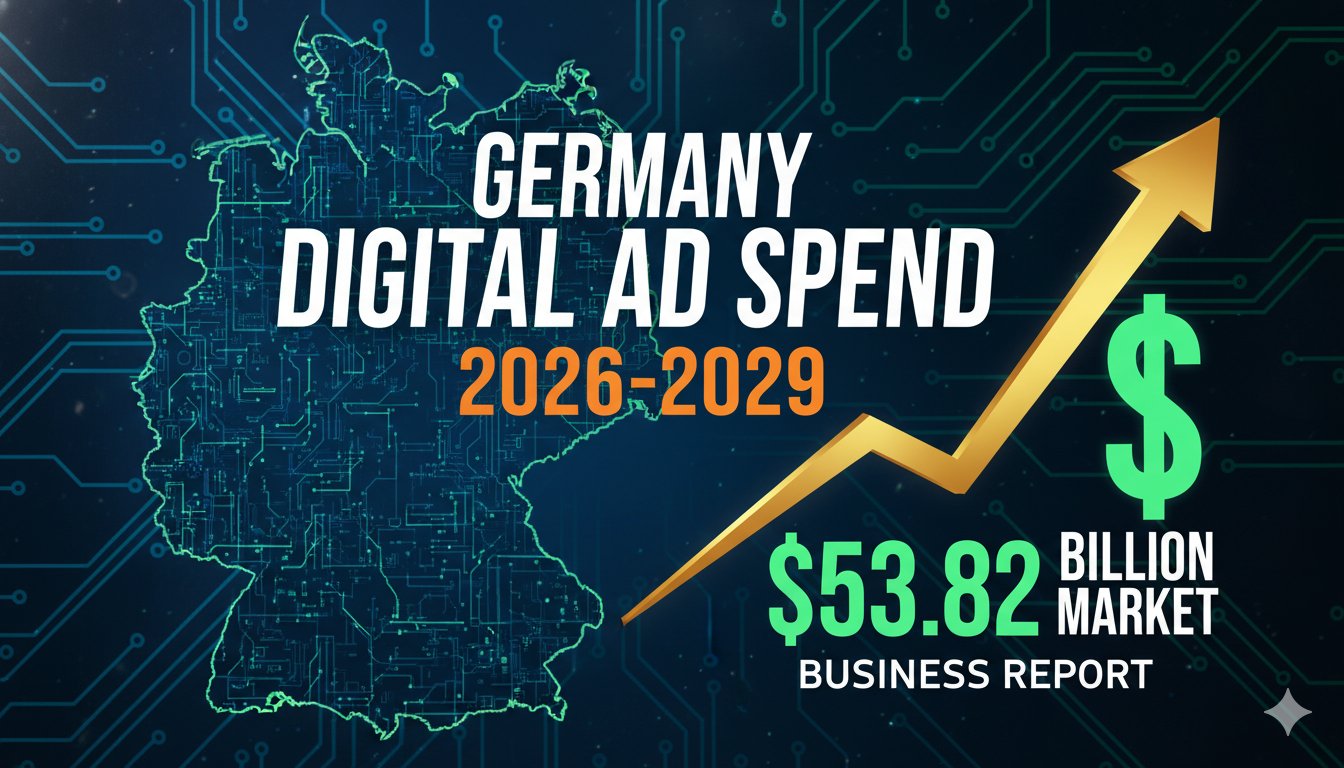
Germany’s digital advertising market is poised for robust expansion, with spending projected to reach US$40.32 billion in 2026 and climb to US$53.82 billion by 2029, reflecting a compound annual growth rate (CAGR) of approximately 10.1% from 2026 onward. This growth builds on a strong historical trajectory, driven by the ongoing shift from traditional to digital channels, heightened e-commerce activity, mobile dominance, and advancements in targeted and programmatic advertising. Key segments like search, video, and retail media are leading the charge amid economic resilience and increasing advertiser investment in data-driven strategies.
Germany’s Digital Advertising Surge: Pathways to a $53.82 Billion Horizon by 2029
Germany’s digital ad market continues to demonstrate remarkable momentum as the country solidifies its position as one of Europe’s largest and most mature digital economies. With high internet penetration exceeding 95% of households and widespread smartphone adoption, consumers spend significant time across online platforms, fueling advertiser reallocation from legacy media to high-ROI digital formats.
In recent years, the market has benefited from accelerated digital transformation accelerated by e-commerce growth, social media engagement, and connected devices. Advertisers are prioritizing performance-oriented channels that deliver measurable results, such as search engine marketing and programmatic buying, while emerging areas like retail media networks gain traction through partnerships with major grocers and online marketplaces.
Current Market Snapshot and Near-Term Projections
The digital ad spend in Germany stands at a substantial level heading into 2026, with forecasts indicating annual growth around 9-10% in the immediate term. By 2026, the market is expected to hit US$40.32 billion, reflecting sustained double-digit momentum in key sub-sectors despite broader economic headwinds like cautious consumer spending in some periods.
This positions Germany ahead of many peers in Western Europe for consistent expansion, supported by a sophisticated advertising ecosystem that includes global tech giants alongside strong local players in publishing and retail.
Long-Term Forecast: Reaching $53.82 Billion by 2029
Looking further ahead, the trajectory points to US$53.82 billion in digital ad expenditure by 2029. This represents a solid CAGR of 10.1% from the 2026 baseline, outpacing overall economic growth and underscoring digital’s dominance in the advertising mix.
The acceleration from 2026 to 2029 stems from several compounding factors:
Increasing reliance on AI-driven targeting and personalization to boost engagement and efficiency.
Expansion of retail media as major retailers build proprietary ad platforms for on- and off-site inventory.
Growth in video and connected TV (CTV) formats, appealing to audiences shifting toward streaming services.
Rising programmatic penetration, enabling automated, real-time bidding across diverse inventory sources.
Breakdown by Key Advertising Formats
Digital formats are diversifying rapidly, with no single channel monopolizing spend but several showing outsized contributions.
| Format | Approximate Share (Recent Data) | Key Growth Drivers | Projected Trend to 2029 |
|---|---|---|---|
| Search Engine Advertising | ~35% | Intent-based queries, e-commerce integration | Remains dominant, steady high-single-digit growth |
| Digital Banner/Display (incl. Social) | ~24% | Broad reach, social platforms’ scale | Moderate growth, boosted by social video |
| Digital Video (incl. CTV & Social) | ~17% | Emotional storytelling, streaming surge | Strongest growth area, double-digit CAGR |
| Email Marketing | ~8% | Direct, personalized communication | Stable, incremental gains from automation |
| Influencer & Affiliate | ~3-7% combined | Authenticity, performance tracking | Accelerating, especially micro-influencers |
| Digital Out-of-Home | ~5-6% | Urban targeting, programmatic DOOH | Fastest riser in non-traditional digital |
Video advertising, particularly short-form on social and longer content on streaming, is emerging as a high-growth engine due to its ability to capture attention in a fragmented media landscape.
Industry Sector Contributions
Digital ad investments vary significantly by vertical, creating a “two-speed” market in some analyses.
Leading sectors include:
Retail and e-commerce: Heavy spenders leveraging retail media and performance channels.
Automotive: Recovery-driven investments in targeted online campaigns.
Travel and leisure: Rebounding strongly post-pandemic with high digital reliance.
Financial services: More conservative growth, focusing on compliance-friendly formats.
Sectors like retail and travel often see 15-18% annual increases in digital budgets, while others trail at single digits, highlighting opportunities for targeted strategies.
Platform and Device Shifts
Mobile remains the cornerstone, accounting for the majority of ad impressions and spend due to ubiquitous smartphone usage. Smartphone-driven formats lead revenue generation, with apps, mobile web, and in-app environments dominating.
Cross-device targeting and unified measurement are becoming standard as consumers move seamlessly between phones, tablets, desktops, and connected TVs.
Challenges and Opportunities Ahead
While growth is robust, advertisers navigate privacy regulations, cookie deprecation, and the need for first-party data strategies. These challenges spur innovation in contextual targeting, consented data pools, and AI-enhanced creative optimization.
Opportunities abound in retail media expansion, where grocers and marketplaces offer high-intent audiences, and in emerging formats like audio and interactive experiences.
The path to $53.82 billion by 2029 will hinge on continued adaptation to consumer behaviors, technological advancements, and efficient capital allocation in a competitive landscape.
Disclaimer: This article is for informational purposes only and does not constitute financial, investment, or legal advice. Market projections are based on industry analyses and subject to change due to economic, regulatory, or technological developments.