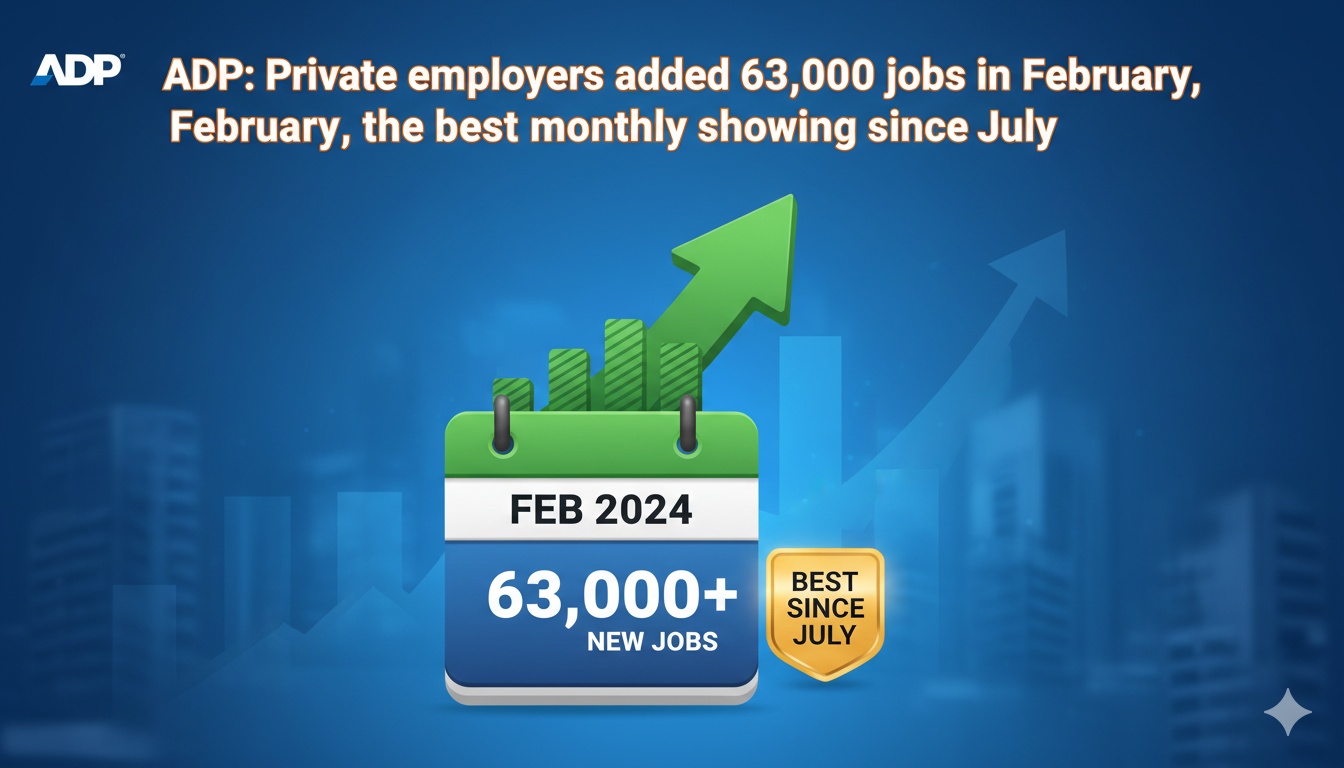
Private sector payrolls rose by 63,000 in February, surpassing expectations of around 50,000 and rebounding sharply from a revised 11,000 gain in January. Gains were concentrated in construction and education/health services, while manufacturing and professional/business services saw declines. Annual pay growth for job-stayers held steady at 4.5%. The report points to a labor market that is thawing amid ongoing economic uncertainties, setting the stage for the official nonfarm payrolls data.
Private Sector Hiring Rebounds in February with Strongest Gain in Seven Months
U.S. private employers stepped up hiring in February, adding 63,000 jobs according to the latest ADP National Employment Report. This figure comfortably exceeded economist forecasts clustered around 50,000 and represented a significant improvement over January’s performance, which was revised downward to just 11,000 jobs added from an initial reading of 22,000.
The February increase marks the best monthly showing since July 2025, when gains were more robust amid different economic conditions. After a period of subdued activity late last year and into early 2026—with outright declines in some months—the latest data suggests businesses are regaining confidence to expand headcounts, even as broader uncertainties around trade policies, interest rates, and growth persist.
Sector breakdowns reveal a clear divide between growth areas and those still contracting. Construction led the way with a solid 19,000 job increase, reflecting ongoing demand for infrastructure and residential building despite elevated material costs and borrowing rates. Education and health services also contributed substantially, continuing their role as a reliable engine for employment amid demographic trends and steady healthcare needs.
On the flip side, manufacturing shed 5,000 positions, extending a string of weakness tied to softer global demand and supply chain adjustments. Professional and business services likewise posted losses, though specific drivers here include caution in corporate spending on consulting and administrative functions.
Other services showed mixed results: information added 11,000 jobs, potentially boosted by tech-related roles, while trade, transportation, and utilities dipped by 1,000. Financial activities edged up modestly by 2,000, and natural resources/mining gained 2,000.
Sector Breakdown for February Job Changes
Goods-Producing Sectors
Natural resources and mining: +2,000
Construction: +19,000
Manufacturing: -5,000
Service-Providing Sectors
Trade, transportation, and utilities: -1,000
Information: +11,000
Financial activities: +2,000
Professional and business services: (decline, magnitude contributing to overall moderation)
Education and health services: (significant gain, key driver alongside construction)
The concentration of gains in just a few sectors underscores the uneven nature of the recovery. While construction and healthcare-related fields benefit from structural demand, cyclical industries like manufacturing remain pressured.
Wage trends remained stable, with annual pay for job-stayers rising 4.5% year-over-year—the same pace as in January. This consistency indicates that wage pressures have moderated from earlier peaks but are not accelerating anew, offering some relief on the inflation front even as hiring picks up.
For context, the broader 2025 picture showed private job growth slowing markedly to around 398,000 for the full year, down from 771,000 in 2024, highlighting a cooling trend that carried into early 2026 before February’s uptick.
The ADP data, derived from anonymized payroll records of millions of employees, serves as an early indicator ahead of the government’s official nonfarm payrolls report. Markets will parse February’s figures closely for clues on Federal Reserve policy, consumer spending power, and overall economic resilience.
With hiring showing signs of life in key areas, attention now turns to whether this momentum can broaden across more industries or if headwinds from policy shifts and global factors will cap further progress.
Disclaimer: This is for informational purposes only and does not constitute financial, investment, or employment advice. Labor market data can be revised and should be viewed in the context of multiple economic indicators.