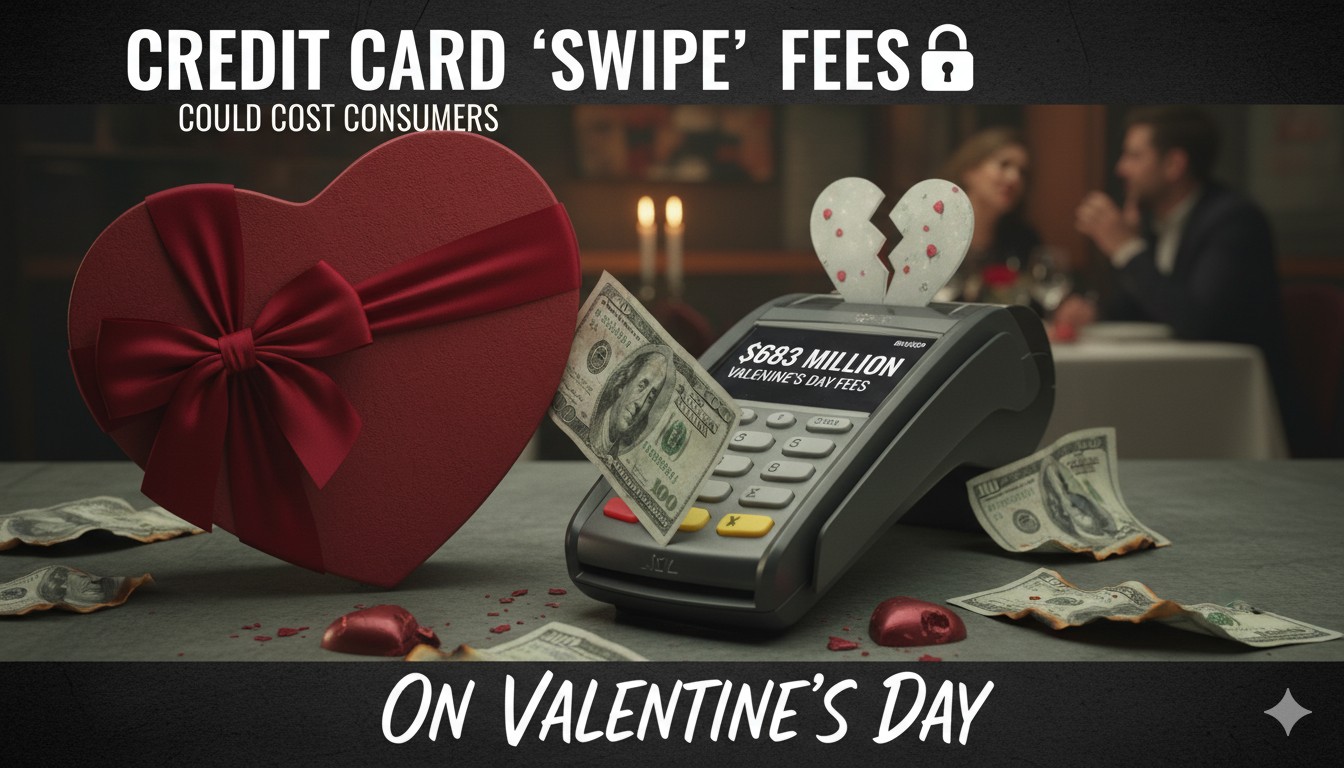
## Credit Card ‘Swipe’ Fees Could Cost Consumers $683 Million on Valentine’s Day
“This Valentine’s Day, Americans are projected to spend a record $29.1 billion on romance-related purchases, but hidden credit card swipe fees—averaging around 2.35% for major networks—could quietly add up to $683.9 million in extra costs passed on through higher prices, equivalent to the price of a greeting card or a few pieces of chocolate per average spender.”
Swipe Fees Weigh Heavy on the Most Romantic Day of the Year
Swipe fees, also known as interchange fees, represent the charges merchants pay to card networks like Visa and Mastercard—and often to issuing banks—every time a consumer swipes, taps, or enters a card for payment. These fees have surged in recent years, climbing roughly 70% since the pandemic era and hitting a record $187.2 billion nationwide in 2024 alone. For many small businesses, particularly in retail, dining, and floristry, they rank as one of the largest operating expenses after labor.
This Valentine’s Day, the impact hits home for millions of consumers celebrating with gifts and experiences. The National Retail Federation forecasts total spending at $29.1 billion, with an average outlay of $199.78 per person on items like candy, flowers, jewelry, greeting cards, clothing, and dining or entertainment. Assuming all transactions occur via credit cards at the average 2.35% rate for Visa and Mastercard, that translates to roughly $4.69 in embedded fees per shopper—small individually but massive in aggregate at $683.9 million. This figure marks an increase from the prior year’s estimated $621.5 million, reflecting both higher overall spending and persistently elevated fee rates.
Merchants rarely absorb these costs fully. Instead, they are frequently baked into product pricing across the board, meaning cash payers and card users alike end up subsidizing the system. For premium rewards cards, which often carry fees exceeding 3% or even approaching 4%, the burden grows steeper, disproportionately affecting higher-end purchases like jewelry or upscale dinners.
Breakdown of Projected Swipe Fee Costs by Category
The $683.9 million total distributes unevenly across popular Valentine’s Day categories, highlighting where the fees bite hardest:
Jewelry : Expected spending of $7 billion could generate approximately $164.5 million in swipe fees.
Evenings out (dining and entertainment) : $6.3 billion in projected outlays may contribute around $148 million.
Clothing : $3.5 billion could add about $82.3 million.
Flowers : $3.1 billion might result in roughly $72.9 million.
Other categories, including candy, greeting cards, and miscellaneous gifts, fill out the remainder.
Real-world examples illustrate the per-transaction sting:
A $160 bouquet of classic red roses might carry $3.76 in fees.
A $64 box of premium chocolates could include $1.50.
A $200 dinner for two (including tip) often exceeds $5 in combined fees.
Adding a $50 bottle of wine or champagne tacks on another $1.17.
These amounts, while modest on single receipts, compound across the day’s massive volume and contribute to broader price pressures on romance-driven retail.
Broader Context: Rising Fees and Ongoing Debate
Swipe fees have long been a flashpoint in U.S. payments policy. Critics argue they disproportionately burden small merchants and inflate consumer prices, while supporters point to the value provided through fraud protection, rewards programs, and network infrastructure. Recent years have seen accelerated growth in these charges, outpacing inflation and squeezing margins for independent retailers, restaurants, and florists—sectors central to Valentine’s Day commerce.
The Merchants Payments Coalition, representing merchant interests, has spotlighted this holiday as a prime example of how unchecked fees ripple through the economy. President Donald Trump has previously described the system as an “out of control Swipe Fee ripoff,” echoing calls for reform. Ongoing legislative and regulatory discussions, including potential caps or structural changes to interchange, remain active, though no sweeping federal overhaul has materialized yet.
For consumers, the takeaway is straightforward: the convenience of plastic comes with an invisible tax. On a day dedicated to love and generosity, that hidden cost underscores the need for awareness—whether opting for cash where possible, choosing lower-fee payment methods, or simply recognizing how everyday transactions fund a multi-billion-dollar ecosystem.
Disclaimer: This is a news report based on industry estimates and public data; it does not constitute financial advice, investment recommendations, or endorsements of any policy position.