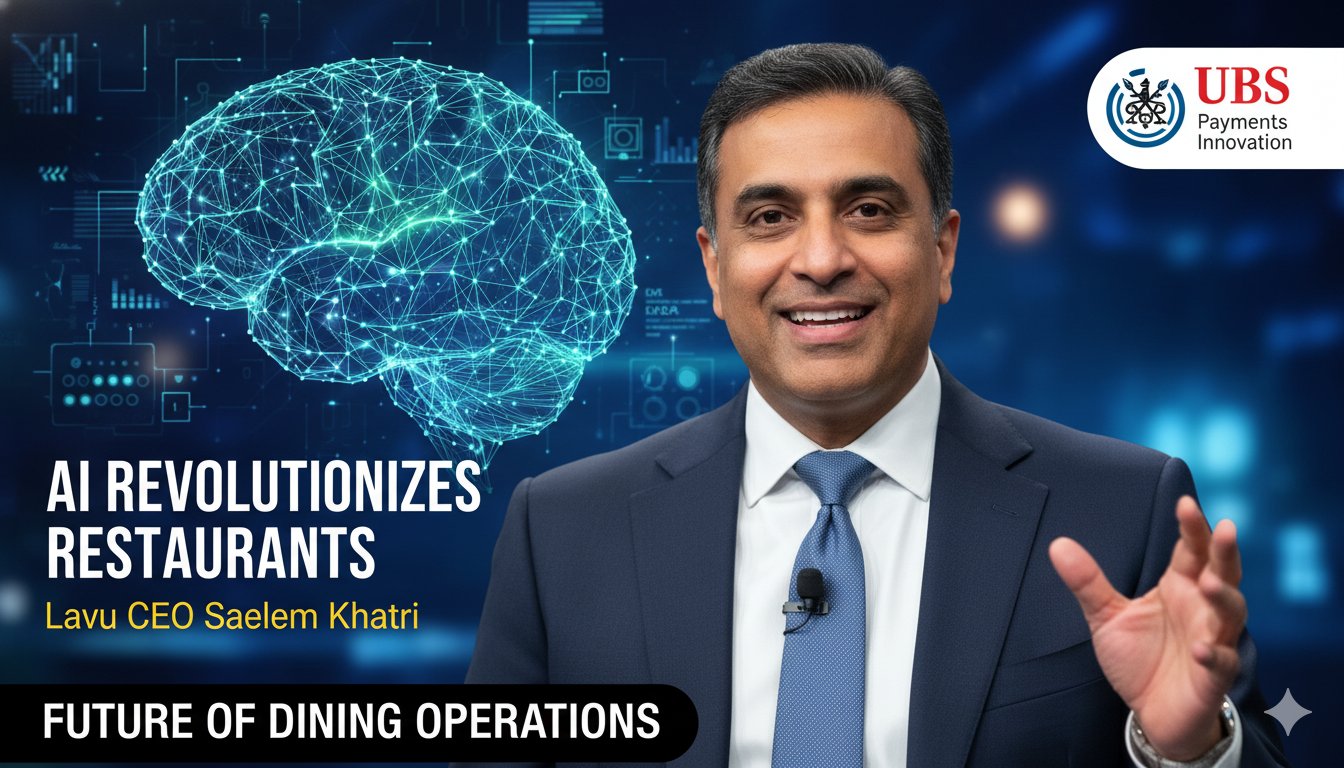
“Lavu’s CEO Saleem S. Khatri is slated to address the UBS Payments Innovation Event Series, emphasizing the transition from passive data reporting to active operational safeguards in restaurant management. He will highlight how AI tools like Lavu’s Marty can combat profit-eroding issues such as compliance risks, labor inefficiencies, and operational oversights, positioning the platform as a vital shield for operators in a commoditized POS landscape.”
In the rapidly evolving intersection of fintech and hospitality, Lavu’s chief executive is preparing to share insights on how artificial intelligence is reshaping the foundational elements of restaurant profitability. The discussion will center on the maturation of point-of-sale (POS) systems and payment processing, which have increasingly become standardized offerings across the industry. Khatri plans to articulate a forward-looking perspective: the true value creation now lies in layering intelligent defenses atop these core functions to preempt financial leaks that plague operators.
Central to this narrative is the concept of moving beyond retrospective analysis—where managers sift through historical data to understand past performance—to a proactive model that intervenes in real time. This shift addresses what industry insiders term the “Three Silent Killers” of restaurant margins: compliance liabilities that accrue unnoticed, labor drift where hours and roles misalign with needs, and negligence in oversight that allows small errors to compound into significant losses. By integrating AI, platforms can function as vigilant overseers, scanning operations continuously and flagging anomalies before they solidify into irreversible costs.
Khatri’s background in finance and technology equips him uniquely for this dialogue. Having navigated roles in investment management and government financial stability efforts, he brings a rigorous analytical lens to the hospitality sector. His leadership at Lavu has focused on transforming the company from a mobile POS provider into a comprehensive AI-powered ecosystem that serves high-growth establishments globally. This expertise will be on display as he converses with a seasoned fintech analyst, exploring how these innovations create durable economic advantages for restaurant groups.
The Role of AI in Combating Operational Risks
At the heart of Lavu’s approach is its proprietary AI engine, designed to operate as a continuous risk auditor rather than a mere dashboard tool. This system ingests vast arrays of data signals daily—from payroll entries and inventory movements to labor scheduling and payment flows—analyzing patterns that human managers might overlook amid the chaos of daily service. For instance, it detects “labor bombs,” which are subtle but dangerous accumulations like unintended overtime extensions, phantom shifts from scheduling errors, or minor regulatory infractions that could lead to hefty fines.
Unlike traditional reporting software that requires manual logins and chart interpretations, this AI delivers autonomous alerts and recommendations. It empowers owners to act preemptively, potentially reclaiming the 8-12% of annual revenue that studies show is typically eroded by inefficiencies in the sector. For multi-unit operators, this translates to scaled protection across locations, ensuring consistency in financial health without constant human intervention.
Industry-Wide Financial Pressures and AI’s Mitigation Potential
The U.S. restaurant landscape faces mounting economic headwinds, with operators grappling with escalated labor expenses, supply chain disruptions from policy shifts, and persistent inflation on commodities and energy. Recent surveys indicate that nearly all establishments—96%—are contending with higher wage bills compared to prior periods, prompting 68% to adjust menu pricing upward. Debt burdens, while easing slightly to affect two-thirds of independents, remain a drag on expansion and reinvestment.
In this context, AI emerges as a critical lever for resilience. Trends point to widespread adoption, with over 80% of operators planning amplified investments in the technology. Beyond basic automation, AI is enabling predictive forecasting for demand, which optimizes staffing and reduces waste. Real-time inventory tracking, for example, minimizes overstocking or shortages, directly bolstering bottom lines in an environment where margins hover in the low single digits for many.
Key Innovations in Restaurant Fintech
| Challenge | Impact on Restaurants | AI-Driven Solutions |
|---|---|---|
| Rising Labor Costs | 96% of operators report increased spending, straining budgets and leading to overtime creep. | AI schedules based on historical patterns and forecasts, alerting to drift before costs escalate. |
| Compliance Liabilities | Unnoticed violations accumulate into fines, eroding 2-5% of profits annually. | Continuous auditing flags risks like minor law breaches in real time, preventing lock-in of penalties. |
| Inventory and Supply Volatility | Tariff policies disrupt chains, inflating costs for 82% of establishments. | Predictive analytics adjust orders dynamically, reducing waste and stabilizing expenses. |
| Operational Negligence | Small oversights, such as ghost shifts, compound to 8-12% revenue loss. | Autonomous scanning identifies anomalies across payroll and operations, enabling immediate corrections. |
The commoditization of POS and payments has democratized access to efficient transaction handling, but it has also intensified competition, pushing providers to differentiate through advanced layers. Lavu’s integration of enterprise-grade payments with AI risk management exemplifies this evolution, allowing seamless data flow that informs both financial processing and operational decisions. This holistic approach not only streamlines workflows but also fortifies against fraud and inefficiencies, areas where traditional systems fall short.
For high-growth chains, the ability to monitor every dollar across global footprints—spanning over 75 markets—offers a competitive edge. Features like dual pay rate handling for tipped staff, integrated accounting exports, and customizable reporting further enhance control, turning what was once a reactive back-office function into a strategic asset.
Broader Implications for Fintech and Hospitality Convergence
As fintech permeates main street businesses like restaurants, events such as this underscore the potential for cross-sector value creation. AI’s role in fraud prevention, personalized pricing, and workflow optimization is accelerating, with full-scale deployments replacing pilot programs. This not only aids individual operators but also stabilizes the broader ecosystem, where resilient restaurants contribute to economic vitality in communities.
Operators adopting these tools report improved guest experiences, as freed-up managers focus on service rather than administrative burdens. In a low-margin industry, where every percentage point counts, such defenses could redefine success metrics, shifting from survival to scalable growth.
Disclaimer: This news report is for informational purposes only and does not constitute financial advice, tips, or recommendations. Sources are from public information.