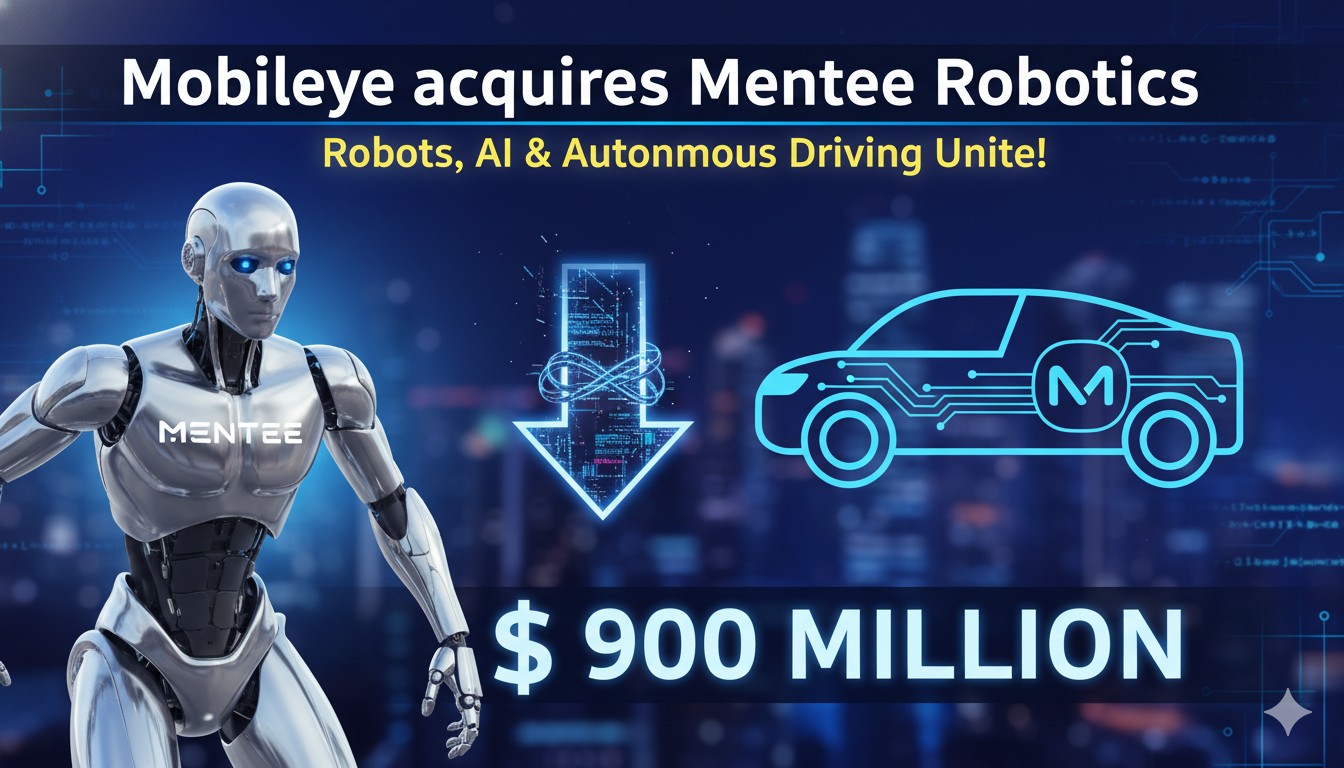
Mobileye Global Inc. has agreed to acquire Israeli humanoid robotics startup Mentee Robotics for approximately $900 million in a cash-and-stock deal. The move positions the autonomous driving technology leader to expand into “physical AI,” combining its expertise in computer vision and sensing with Mentee’s advanced general-purpose humanoid platform. Shares of Mobileye surged on the news, reflecting investor optimism about diversification beyond automotive applications.
Deal Details and Strategic Rationale
Mobileye, a pioneer in advanced driver assistance systems and autonomous vehicle technology, is making a bold pivot into the rapidly growing field of humanoid robotics. The acquisition of Mentee Robotics, valued at around $900 million, represents a significant investment in what company leadership describes as the next evolution of artificial intelligence embodied in the physical world.
The transaction structure includes roughly $612 million in cash and up to 26.2 million shares of Mobileye Class A common stock, with adjustments possible based on certain conditions. The deal received approval from Mobileye’s board and its largest shareholder, Intel, and is anticipated to close in the first quarter of 2026.
This move integrates Mobileye’s proven strengths in scalable AI production and safety-critical systems with Mentee’s innovative humanoid robot design. Mentee’s platform emphasizes efficient learning through simulation and few-shot demonstrations, allowing robots to adapt quickly to new tasks without extensive real-world data collection or constant human oversight.
Key Synergies Between Mobileye and Mentee
The combination leverages overlapping technologies in perception, navigation, and decision-making:
Market Reaction and Timeline
| Area | Mobileye Contribution | Mentee Contribution | Combined Benefit |
|---|---|---|---|
| AI and Perception | Advanced computer vision and mapping | End-to-end scene understanding and intent inference | Enhanced context-aware reasoning for real-world interaction |
| Learning Approach | Large-scale deployment in vehicles | Simulation-first training and few-shot generalization | Faster skill acquisition with reduced data needs |
| Hardware Integration | EyeQ chips and sensing systems | Proprietary actuators and manipulation hardware | Cost-efficient, robust locomotion and object handling |
| Safety and Scalability | Proven automotive-grade reliability | Safe human-robot interaction design | Economically viable general-purpose robots |
Investors responded positively to the announcement, driving Mobileye shares higher in trading following the reveal at the CES technology conference. The stock closed with gains, underscoring confidence in the strategic expansion amid a competitive landscape where companies like Tesla and others are also pursuing humanoid robotics.
Mentee is expected to operate as an independent unit within Mobileye initially, preserving its focused development pace. Proof-of-concept deployments with customers are targeted for 2026, with full series production and commercialization aimed for 2028. Initial applications are likely to focus on industrial settings, such as warehouses and manufacturing, before broader expansion.
Broader Implications for Physical AI
This acquisition signals Mobileye’s ambition to lead in “physical AI”—systems that not only process information but interact effectively and safely in dynamic environments. By bridging autonomous mobility with humanoid capabilities, the company aims to address labor shortages in logistics and manufacturing while exploring future household applications.
The deal also highlights the convergence of automotive AI expertise with robotics, potentially creating cross-selling opportunities with existing automaker partners who could adopt humanoid solutions for factory automation.
Disclaimer: This article is for informational purposes only and does not constitute investment advice, financial recommendations, or endorsements of any kind. All market data and company information are subject to change.