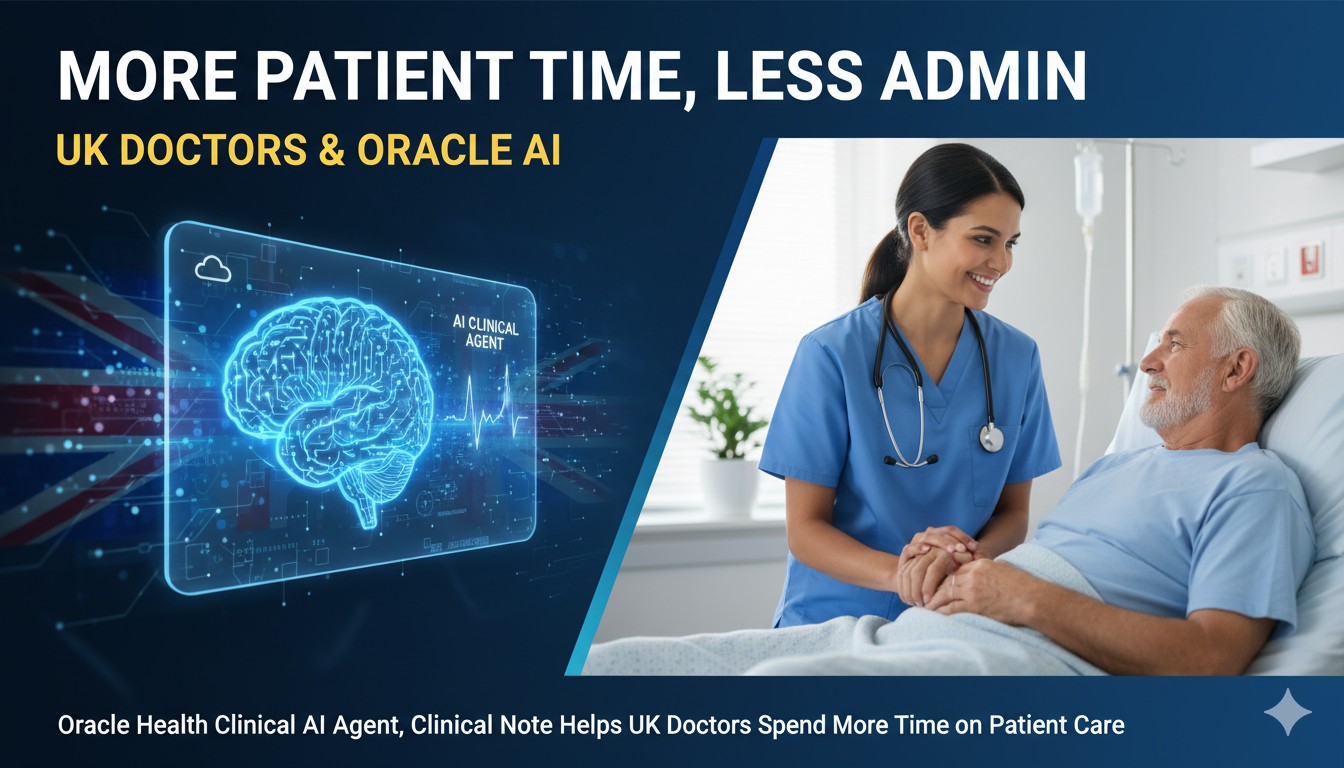
Oracle Health’s Clinical AI Agent, featuring its advanced Clinical Note capability, has launched across the UK following successful pilots at leading NHS Trusts. This ambient AI tool drafts patient notes via voice and screen interactions, slashing documentation time by up to 40% in some cases and allowing clinicians to prioritize direct patient engagement over administrative burdens. Participating hospitals like Barts Health, Imperial College Healthcare, and Milton Keynes University Hospital are expanding deployment, with early users reporting faster note completion, improved team communication, and enhanced care coordination.
Oracle Health Clinical AI Agent Transforms UK Healthcare Documentation
Oracle Health has introduced its Clinical AI Agent with Clinical Note functionality to the United Kingdom, marking a significant advancement in alleviating the heavy administrative load on clinicians within the National Health Service (NHS) and private practices. This AI-powered solution functions as an intelligent ambient assistant, listening to doctor-patient conversations in real time while also responding to screen-based inputs. It then generates accurate draft clinical notes automatically, integrating seamlessly into existing electronic health record systems.
The rollout comes after a rigorous pilot phase involving prominent NHS Trusts. At Barts Health NHS Trust, Imperial College Healthcare NHS Trust, and Milton Keynes University Hospital, the tool demonstrated tangible improvements in workflow efficiency. Clinicians reported substantial reductions in the time spent typing or navigating dropdown menus, with some estimates indicating documentation demands dropping by around 40%. This shift enables physicians to maintain eye contact with patients, listen more attentively, and deliver more personalized care without the constant interruption of record-keeping.
One consultant in acute medicine at Milton Keynes University Hospital highlighted the practical impact: the ability to finalize consultation letters and share them with patients before they leave the department. This immediacy not only boosts patient satisfaction but also ensures that subsequent clinicians on the team have instant access to updated plans, fostering better continuity of care. Previously, delays in note availability often fragmented team handoffs, but the AI’s rapid drafting changes that dynamic.
The Clinical AI Agent operates multimodally, combining voice recognition for ambient capture during consultations with screen-driven commands for refinements or additional details. It draws on comprehensive clinical context, including patient history, prior interactions, and relevant medical knowledge, to produce structured, high-quality drafts. These drafts remain under clinician review and approval, preserving professional judgment while minimizing manual entry. The tool supports various specialties and adapts to individual clinician preferences over time, learning favored phrasing or formatting to make outputs even more efficient.
In broader terms, administrative burdens have long contributed to clinician burnout in the UK healthcare system, where doctors frequently cite excessive paperwork as a barrier to job satisfaction and patient interaction. By automating note generation, Oracle Health addresses this core issue head-on. Early data from U.S. deployments—where the agent has saved over 200,000 clinician hours—suggest similar potential in the UK context. Reduced documentation time translates to more availability for complex cases, preventive discussions, or simply building rapport with patients.
The solution also enhances care coordination across teams. With notes drafted and available in minutes, multidisciplinary teams gain quicker insights into assessments and plans. This capability proves especially valuable in busy acute settings or outpatient clinics, where rapid information sharing can influence treatment decisions and reduce errors from outdated records.
Deployment is scaling rapidly among pilot sites, with trusts integrating the tool into daily operations. Private practices are also adopting it, recognizing the value in streamlining workflows amid growing patient volumes. Oracle Health emphasizes that the AI prioritizes accuracy and compliance, generating suggestions grounded in real-time conversation analysis and established clinical guidelines.
Key benefits observed include:
Time savings — Clinicians reclaim hours previously lost to typing and menu navigation.
Improved patient experience — Greater focus on conversation rather than screens leads to higher engagement.
Team efficiency — Immediate note availability supports seamless handoffs and collaborative care.
Burnout reduction — Less administrative drudgery allows professionals to operate at the top of their license.
As the UK healthcare system grapples with workforce pressures and rising demand, tools like this represent a practical step toward sustainable practice. The Clinical AI Agent positions Oracle Health as a leader in embedding generative AI directly into clinical workflows, with ongoing enhancements expected to further expand its utility.
Disclaimer: This is a news report based on industry developments and does not constitute medical, investment, or professional advice.