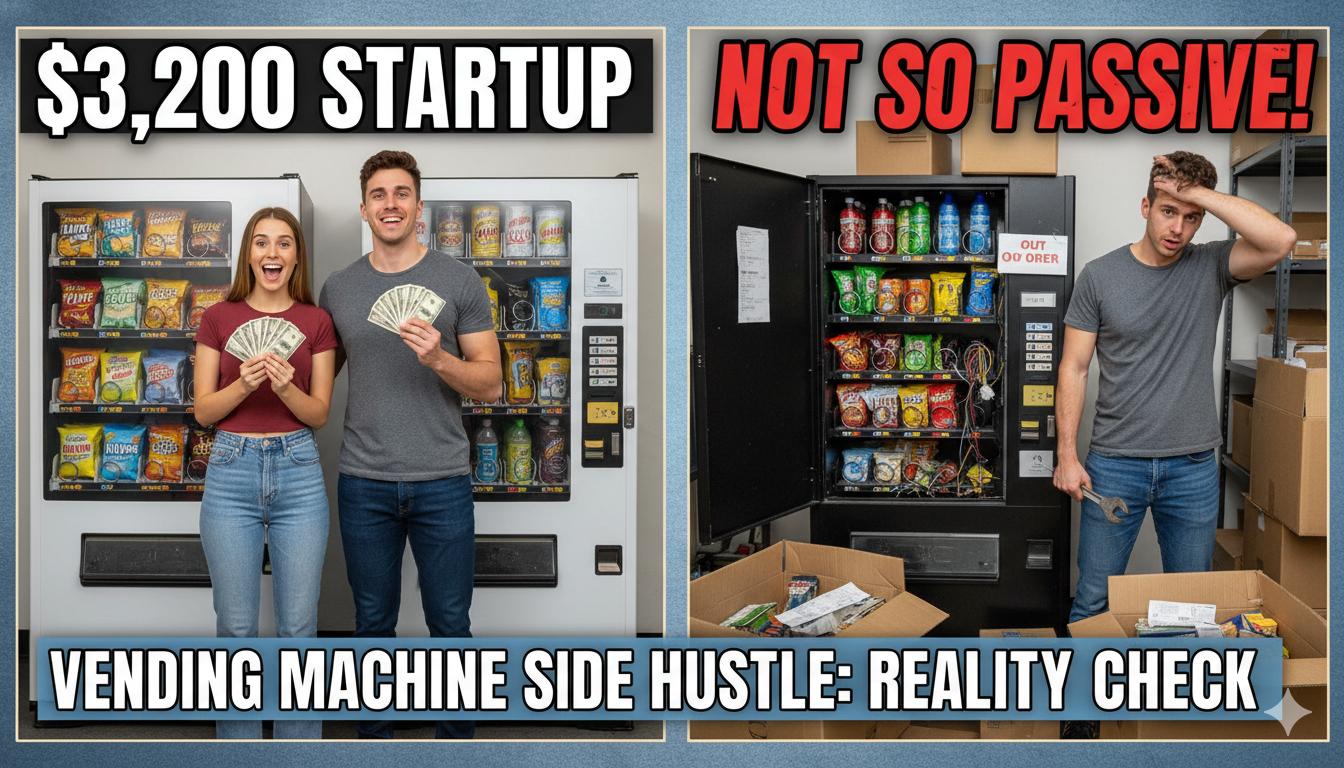
“A young couple in the Midwest plunged $3,200 into two refurbished vending machines to launch a side hustle amid rising interest in automated retail ventures. Half a year in, they’ve netted modest profits but uncovered the hands-on demands of restocking, repairs, and site management in an industry valued at over $20 billion in the U.S., highlighting why many underestimate the effort required for what’s often billed as easy money.”
They Spent $3,200 On Two Vending Machines To Start A Side Hustle. Six Months Later, They Say, ‘It’s Not As Passive As People Make It Sound’
In the bustling landscape of American side hustles, where entrepreneurs seek streams of income that fit around full-time jobs, vending machines have surged in popularity. With the U.S. vending machine market hovering around $21 billion this year and projected to climb toward $30 billion by the end of the decade at a compound annual growth rate of about 3.6%, it’s no wonder more individuals are dipping into this sector. Yet, for one couple—let’s call them Alex and Jordan—the journey began with high hopes and a modest outlay, only to reveal layers of complexity that challenge the myth of effortless earnings.
The Spark and Initial Setup
Alex, a software developer, and Jordan, a teacher, were drawn to the idea after scrolling through online forums and videos touting vending as a low-effort path to supplementary cash. With inflation pinching household budgets and the average American side hustle now contributing an extra $1,000 to $2,000 monthly for many, they saw potential. They scoured marketplaces for deals, landing two refurbished snack-and-drink combo machines for a total of $3,200—about $1,600 each, including minor upgrades like card readers for cashless payments, which now account for over 70% of transactions in the sector.
Adding to that, they shelled out roughly $500 on initial inventory: popular items like chips, candy bars, energy drinks, and bottled water, sourced from wholesale clubs to keep costs under $0.50 per unit for resale at $1.50 to $2.50. Securing locations proved trickier than anticipated. After cold-calling dozens of businesses, they placed one machine in a mid-sized office building’s break room and the other in a local gym’s lobby, agreeing to revenue splits of 20% with the hosts. This setup aligned with industry norms, where operators often pay commissions ranging from 10% to 30% to site owners for the privilege of placement.
Operational Realities: Beyond the Plug-and-Play Myth
From day one, the couple envisioned a setup where machines hummed along autonomously, requiring only occasional check-ins. Reality hit differently. Restocking became a bi-weekly ritual, consuming 4-6 hours per session. Driving to wholesalers, loading up their SUV, and refilling slots while tracking expiration dates turned into a logistical puzzle. “We thought it’d be set-it-and-forget-it,” Alex recalls, “but monitoring sales data via the machines’ apps showed us patterns—like peak demand during lunch hours—that meant adjusting inventory constantly to avoid stockouts or waste.”
Maintenance emerged as another time sink. One machine jammed twice in the first month due to a faulty coin mechanism, leading to lost sales and a $150 repair bill from a local technician. The other faced vandalism at the gym, with scratches and a dented door costing $200 to fix. These incidents echo broader industry hurdles, where operators report average annual maintenance expenses of $300 to $500 per machine, not including downtime that can slash revenue by 20-30% if unresolved quickly.
Location dynamics added further strain. The office site performed steadily, pulling in $300-400 monthly in gross sales, buoyed by white-collar workers grabbing quick snacks. The gym, however, underdelivered at $200-250, hampered by competition from an on-site cafe and fluctuating membership traffic. Relocating proved challenging; finding new spots involved negotiating contracts and competing with established vendors, a process that took weeks and highlighted why 40% of new entrants cite site acquisition as their top barrier.
Financial Breakdown: Numbers Behind the Hustle
To provide clarity on the economics, here’s a detailed snapshot of their first six months’ performance, based on tracked expenses and revenues. While individual results vary, this mirrors averages from operators managing small fleets, where net profits per machine often range from $50 to $400 monthly after costs.
| Category | Initial Costs | Monthly Average (Per Machine) | Six-Month Total (Two Machines) |
|---|---|---|---|
| Machine Purchase | $3,200 | N/A | $3,200 |
| Initial Inventory | $500 | $150 (restocking) | $1,800 |
| Transportation (Gas/Mileage) | $100 | $50 | $400 |
| Maintenance/Repairs | $0 | $40 | $480 |
| Location Commissions | N/A | $60 (20% of gross) | $720 |
| Gross Revenue | N/A | $275 | $3,300 |
| Net Profit | N/A | $25 | $300 |
Breaking it down further, gross margins on products averaged 50-60%, with snacks yielding higher returns than drinks due to lower spoilage risks. After deductions, the duo cleared about $50 monthly per machine, totaling $600 over six months—a far cry from the $1,000+ projections they’d seen online. Scaling would help; industry data shows that fleets of 10+ machines can achieve economies, reducing per-unit costs by 15-20% through bulk buying and route optimization. But for a duo with day jobs, expanding meant weighing time commitments against returns.
Key Challenges in the Vending Landscape
Diving deeper, several systemic issues plague small-scale operators like Alex and Jordan:
Inventory Management: Balancing variety is key. They learned to rotate items based on sales data—ditching slow-moving granola bars for trending energy gels—but waste from expired goods ate into 5-10% of profits. With consumer preferences shifting toward healthier options (now 25% of vending sales), adapting requires constant market vigilance.
Technology Integration: Their machines’ basic telemetry helped track remote sales, but upgrading to AI-driven systems for predictive restocking could cost $500-1,000 per unit. In a market where smart machines are growing at 8% annually, lagging tech means missed efficiencies.
Competition and Market Saturation: The U.S. boasts over 5 million vending machines, with density highest in urban areas. New entrants face rivalry from giants like Cantaloupe and Crane, who dominate with networked fleets offering real-time analytics. For side hustlers, this translates to tougher negotiations for prime spots like airports or hospitals, where foot traffic can boost earnings by 50%.
Regulatory and Economic Pressures: Varying state sales taxes (averaging 6-7% on vended goods) and compliance with health codes for food handling add administrative burdens. Rising wholesale prices, up 5% this year due to supply chain ripples, squeezed margins further.
Scaling Strategies and Industry Insights
Despite the hurdles, the couple isn’t quitting. They’ve identified paths forward, informed by broader trends. For instance, diversifying into niche machines—like those dispensing fresh salads or electronics—could tap into the 10% market segment growing at double the overall rate. Networking via operator forums has yielded tips on route software that cuts service time by 30%, potentially freeing hours for expansion.
Looking at the bigger picture, the vending sector’s resilience shines through. Post-pandemic recovery has seen installations rebound, with offices and transit hubs leading at 40% of placements. Cashless adoption, now at 77% in high-traffic areas, streamlines operations and boosts impulse buys by 15%. For aspiring hustlers, starting small with refurbished gear keeps barriers low, but success demands treating it as an active business, not a passive one.
Lessons from the Front Lines
Alex and Jordan’s experience underscores a critical truth: while vending can generate steady income— with top operators netting $5,000+ monthly from mid-sized fleets—the “passive” label is misleading. It requires strategic planning, from data-driven product selection to proactive maintenance. For those eyeing entry, budgeting an extra 20% buffer for surprises is wise, as is starting with one machine to test waters before scaling.
In a year where side hustles are projected to add $500 billion to the U.S. economy, vending stands out for its accessibility. Yet, as this couple’s story shows, the real grind lies in the details, turning what seems like a simple box of snacks into a demanding yet rewarding enterprise.
Disclaimer: This news report offers general information and tips on business ventures. It is not financial, investment, or legal advice. Readers should consult qualified professionals before making decisions. Sources are drawn from industry analyses and public reports.